
Manufacturing Will Drive Design: The New Paradigm
In my last post I laid out five shifts I think AI will bring to design and manufacturing. This is the first deep dive, and it’s on the one I think matters most: manufacturing will drive design.
AI is speeding up the old workflow: design driving manufacturing
New AI tools are already changing how design gets done. Geometry is starting to come from prompts instead of mouse clicks, and startups like Flow Engineering are raising venture money to automate parts of hardware engineering. Over time these tools will change how CAD systems are used, and in some cases whether they get used at all. I also expect open-source AI tools to take over more and more of what commercial CAD does today.
Most of these tools, though, are speeding up a workflow we already have. The designer still creates the part first, and manufacturing still finds out what it costs at the end. Getting through the same steps faster is helpful, but it isn’t a new way of working.
What I’m describing is a different workflow. The product developer sets the design intent, and then manufacturing cost data shapes the design itself. What it costs to make comes first, and the design follows from that.
Design is becoming the easy part
I’m not the only one who sees it this way. a16z recently published a piece by Christian Keil called “Superhuman Hardware Design Is The Easy Part”. Keil, who worked on satellite programs at Astranis, points out that the leading AI models can already generate CAD, design circuit boards and source off-the-shelf parts, and the hardware design benchmarks keep improving. He expects AI to become a better hardware designer than people, and soon.

His bigger point is the one that matters here. Keil argues that AI may get very good at pure design, meaning defining the ideal part for a job, and still struggle with design for manufacturing: finding a design that meets the requirements while staying easy and cheap to build. Pure design can happen entirely inside a computer. Design for manufacturing needs information from the real world, and that’s much harder for the models to get.
I agree, and I’d add that the most important real-world information is what it actually costs to make the part.
Why design for manufacturing fell short
DFM has been around for decades, and it’s useful. It checks that the radii are right, the holes match standard drills and cutting tools, and the walls are thick enough to machine.
The problem is that DFM was never really backed by manufacturing cost. It could tell you a feature was makeable. It couldn’t tell you whether you’d picked the right way to make the part in the first place.
DFM could fine-tune a machined part all day long, but it was never going to tell you the part should have been sheet metal.
In the workflow I’m describing, every manufacturing process is on the table, and they’re all compared on real cost.
It starts with parts
This won’t happen all at once. It’s a continuum.
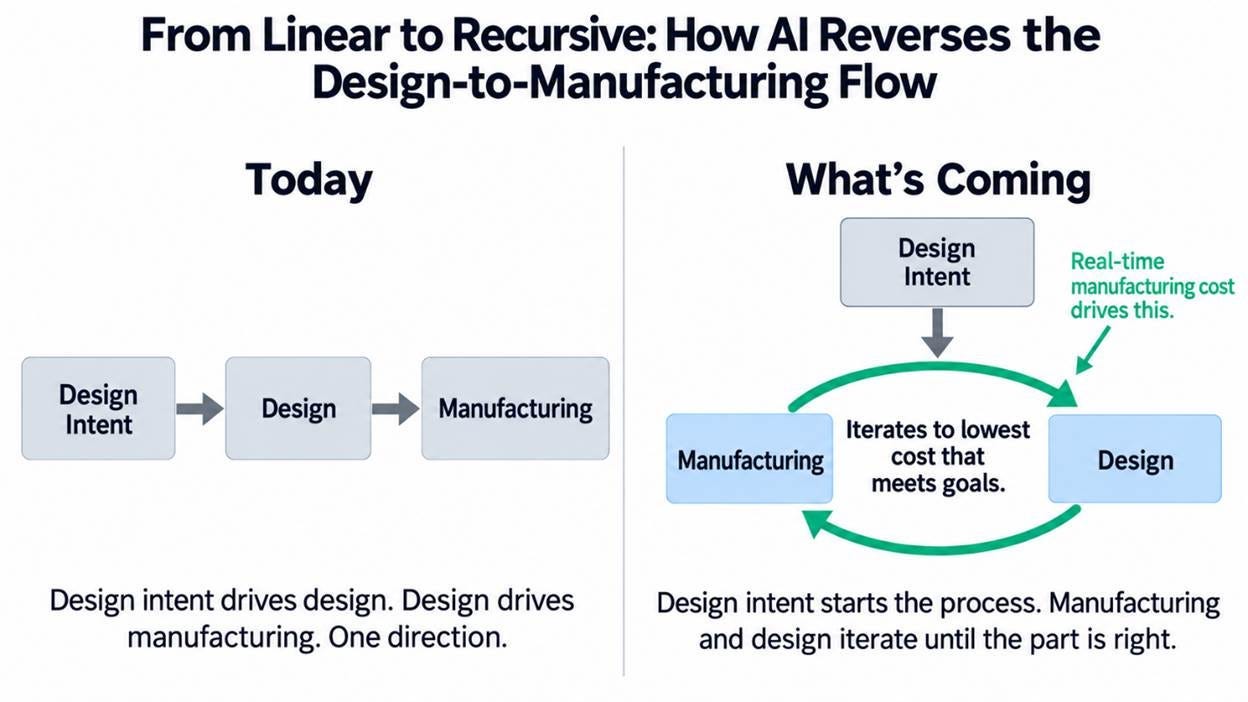
It starts with single parts. Given the design intent, should a part be machined, sheet metal, cast, injection molded or 3D printed? That question can actually be answered today.
Around 2015, an applications engineer at a CAD company ran an experiment on his own. He created a parametric cost engine integrated into his CAD system and let it iterate the geometry. After more than 2,000 iterations it found the lowest-cost version of a sheet metal part. It proved the loop could work. But he knew going in that the part would be sheet metal. The next step is letting cost pick the process too.
From there it grows to sub-assemblies, which is where it gets interesting. One part in one process may replace several parts in another. Two sheet metal pieces welded or fastened together might become a single casting. A machined part might replace a small assembly. One part might be bought while the others are made. To compare options like these, you have to cost a sub-assembly in one process against a single part in another.
Eventually it reaches the whole product, with buy-or-make decisions on every part and sub-assembly. Keil lays out hardware building like a course catalog, 101 through 501: off-the-shelf parts, then custom parts, then assemblies, then outside vendors, and finally production at scale. He also notes that even SpaceX, the poster child for vertical integration, has hundreds of people in supply chain roles. Everyone buys something. Getting all the way to the full product will take time, and it will come as AI models get more capable and the cost of tokens keeps dropping.
The best design
So what is the best design? My opinion is that it’s the lowest-cost design that meets the product developer’s requirements, including quality and lead time.
Quality can be a choice too. A developer who wants the lowest cost and can live with a little less quality could set that as an option in the design. One who needs the highest quality could set that instead. Either way, the trade-off gets made on purpose, using real numbers.
What this requires
This workflow depends on one thing: comprehensive manufacturing cost data across multiple processes, good enough that you can truly compare one process with another.
Estimating cost from geometry and physics isn’t enough, because real prices move around constantly. They depend on the kinds of shops a buyer uses and what those shops can do (and can’t do), on the price of metal, and on the time of year (yes, pricing fluctuates seasonally). A shop trying to fill its backlog will price a job differently from one that already has more work than it wants. Then there’s the cost of quality. I call all of this (and more) manufacturing intelligence. Most of it isn’t public, and it can’t be recreated from synthetic data.
Keil makes a similar point about the physical world in general. Materials vary, processes drift over time, and good data is sparse and expensive to collect. He also says the AI labs will need “process knowledge,” the kind of know-how a veteran machinist builds up over decades, and that the data to approximate it is hard to come by. I’d put real manufacturing cost data in that same category.
So where does this data live today? ERP systems hold order costs, and PLM systems hold product records. In both, though, the cost is only loosely tied to the geometry and the prints. To drive design, cost data has to be connected directly to the geometry and prints it came from, for each process, based on real quotes and orders for production work, and updated as the market changes.
Where this leaves CAD
For CAD companies, this is both a threat and a way forward.
Geometry creation is becoming a commodity. If a prompt can produce a part, and open-source tools can do much of what commercial CAD does, the old value of a CAD seat gets thinner.
The way forward is manufacturing intelligence. Generative design that already looks at several manufacturing methods is a strong foundation. Adding real cost across processes, sub-assemblies and buy-or-make decisions takes it a lot further. And since that cost data isn’t public, open-source tools can’t easily copy it. If a CAD company licenses the data, others can license it too. If the CAD company owns it, that’s what sets it apart.
How it gets built is up to the CAD companies. It could be an AI agent inside the CAD system, or a cost check that runs quietly in the background as the design takes shape. I’m not sure how it will ultimately evolve, and that’s not really the point.
It also opens up new ways to think about cost. A design doesn’t have to stay tied to one process. At 100 units the best answer might be sheet metal. At 1,000 it might be a machined part or a casting. Keil makes the point that building one of something and building a million of it are fundamentally different jobs. With cost built into the design, the process can change as volumes change while the product works exactly the same.
In regulated industries like aerospace, defense and medical, changing processes means requalifying the part, so the design gets locked in. That makes getting it right before certification even more important. If you know at that point that you have the least expensive way to make the part or sub-assembly, you’re already ahead of how it’s done today.
Why I’m excited about this
For me this is the exciting part. Design intent drives manufacturing, and manufacturing drives the design. What comes out is a lower-cost product with the best possible design.
It also takes a lot of the grunt work off designers and product developers. Instead of spending hours on the fine details of geometry and manufacturability, they can focus on what makes their product unique. That’s where their time is best spent.
In the next posts I’ll go deeper into some of the pieces I’ve only touched on here.
If you work on the CAD side or the shop side, I’d like to hear how you see this playing out.