
The theses and paradigm shifts I see coming as AI changes how parts are designed, bought, and made
AI will change everything about how parts are designed, bought, and made.
I founded RAPID, a production prototyper, scaled it, and exited in 2017 for $121 million. The last year we quoted over 100,000 parts and shipped over 40,000 of them in one to two weeks, often less. And most parts we had never seen before and never saw again. I also am a cofounder of Paperless Parts. I host The Job Shop Show. From where I sit, I see five paradigm shifts coming.
This post is the map. Each shift will get its own deep dive in later posts.
It already happened once
Around 2015, an engineer at PTC, the company behind Pro/ENGINEER, got curious. He shared this story with me years later.
RAPID Sheet Metal had built a plugin called SolidQuote. It ran inside of SolidWorks and Pro/ENGINEER. It quoted sheet metal parts automatically, without human involvement, from the geometry (plus a few non-geometric questions the designer answered, such as quantity) right in the CAD system.
One evening, on his own time, the engineer wrote a program to optimize a sheet metal part design for the lowest cost. He used Pro/ENGINEER’s parametric design tools to automatically change the design and get the associated price, then change the design again and get a price, comparing it to the previous price. And again. And again until it ran out of options. It wasn’t a PTC project. He simply was curious and wanted to see if it was possible.
It was. After more than 2,000 iterations, his program landed on the part design that achieved the lowest cost.
He proved it could be done, and then it went nowhere. The concept worked yet everything around it to do part design based upon manufacturing cost didn’t exist. Until now.
Why now
ChatGPT was let loose on the world less than four years ago. Since then, the missing pieces have started to show up:
3D CAD models can be created from prompts. Vector geometry no longer has to come from a person working in a CAD system.
Companies like Flow are starting to piece together different parts of the design cycle.
On the sell side, Xometry and others instantly price parts and take orders. On the buy side, the grassroots of structured demand are forming.
What’s still missing is cost. Design for manufacturing software has been around a long time, and it doesn’t contain accurate, real-time manufacturing costs. Nobody is putting real cost into the design loop.
These five shifts are developing in parallel, on separate tracks. Over the next two to three years, I expect continuous, incremental marches toward all five until they converge. Not every part will be designed or bought this way by then, but a real subset of each will be.
1. Manufacturing will drive design.
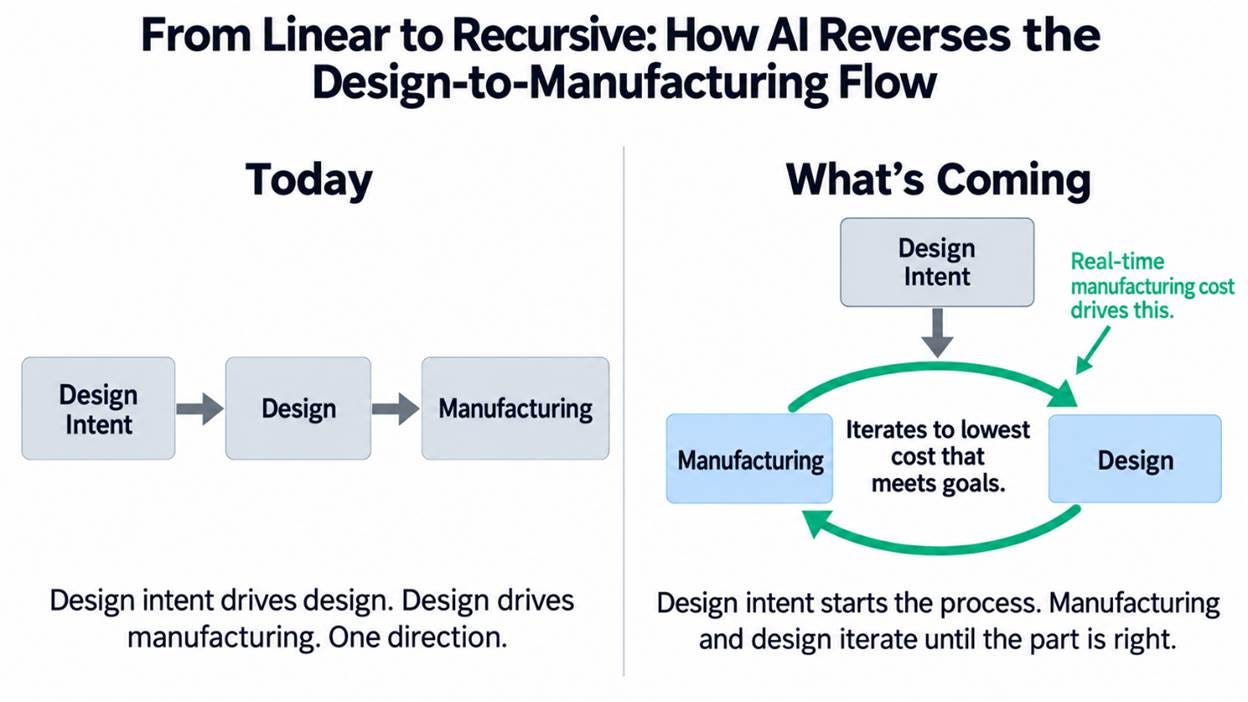
Today, design intent drives design, and design drives manufacturing. Every CAD system and engineering organization is built on that sequence.
Going forward, design intent will drive a recursive process where manufacturing drives design. The design adjusts, over and over, until the part meets its goals at the lowest cost. The designer (or perhaps an agent) sets the intent. The loop finds the part.
Who runs the loop? Not necessarily a person in a CAD seat. If AI can generate geometry from a prompt, an agent can do the work, or a team of agents. Picture the mechanical, electrical, and other engineering disciplines that have to collaborate on a product, each represented by agents, running the loop together.
That software doesn’t exist yet. Flow is a good example of the pieces coming together, but no one produces the entire product design. Someone will. Whether it’s a company like Flow or perhaps the CAD incumbents adapt, I don’t know.
For CAD executives, here’s the question for the boardroom: if geometry comes from a prompt and agents run the loop, what exactly is the CAD company selling?
The loop also needs something to iterate against: accurate, real-time manufacturing cost tied to geometry and prints. That data is scattered across:
PLM systems
ERP systems
Costing and estimating software
Individual shops’ own quote histories
MES and machine-level data
Companies like Harmoni, the Bessemer-backed factory orchestration startup out of Akron OH, are pulling the shop floor together beyond what today’s MES and machine monitoring tools do.
The common view is that AI is eating SaaS. Yet Flow and Harmoni are raising venture money right now. The capital isn’t leaving software. It’s moving to software built for the new loop.
2. The buying and selling of custom parts will be fully automated.
From RFQ to awarding the order, on both sides of the transaction. The sell side is already moving: instant pricing and online ordering are real today. The buy side is earlier, but structured demand is starting to form. Once both sides are automated, agents will buy from agents.
3. A facilitator will connect buyers and sellers.
Automated markets still need someone, or something, in the middle making them work.
Do the math. An OEM might run a million agents. A shop might run ten thousand. And there is a vast universe of shops. Maybe someday, with essentially free and unlimited intelligence, every OEM could talk to every shop. That doesn’t seem possible to me.
Someone has to aggregate what shops can actually do: machine capability, lead times, quality, local differentiations. It has to be a trusted source, so buyers’ agents dive deep only into shops that qualify.
Today, discovery is opaque and expensive on both sides. Sales and marketing reach a narrow window of potential customers, and a huge qualified audience goes untapped on both sides.
The facilitator also creates something neither side can create alone: manufacturing intelligence. Every transaction teaches it something.
A shop can see what kinds of parts are in demand and what shops with similar equipment are winning. That tells it what to buy, where to specialize, and when to add a shift.
A buyer can see where lead times are stretching and where capacity is opening up, so it can plan ahead instead of reacting.
That’s a network effect. The more transactions flow through, the more intelligence is generated and the more valuable the facilitator becomes to both sides. So there won’t be many facilitators. The winner will be whoever has the most transactions and the deepest manufacturing intelligence.
4. Custom part pricing will always be dynamic.
There is no right price.
You make money in the stock market by minimizing your losses and riding your gains. Shops work the same way. They never want to lose money on a part, and sometimes they make more than they expected.
To price without losing money, a shop has to understand many dynamics that are all moving at once such as:
What is material costing?
Will this order mean overtime?
Do we need more equipment, more people, higher wages?
Unless you run medium-high to high production, the hours are never consistent. Demand moves through a shop in waves, some of it seasonal, sometimes across the whole industry, definitely as part of economic cycles. When capacity tightens industry-wide, the price should and will reflect it.
Pricing will update on the fly based on both internal and external influences. Think Uber. That’s dynamic pricing.
5. Custom part pricing will be commoditized.
That sounds like it contradicts dynamic pricing. It doesn’t. Commoditization strips out the opacity. Dynamic pricing is what’s left when every shop prices to its real, moving cost.
As these tools spread, prices come down naturally. But shops don’t want to compete at the bottom. Winning a job just because you’re cheapest does a shop no good. Shops want to price to actual cost plus the profit they desire. That will force them to become more operationally efficient, so they can offer the lowest price at the margin that keeps them in business.
It will also reshape which manufacturers win. Small and large shops will thrive. Medium shops without intention will struggle.
By intention, I mean knowing which parts you make money on and why you’re good at them, and which parts you lose money on and shouldn’t be making (and quoting). Then acting on it: selling equipment that doesn’t fit, and buying equipment that lets you scale what you do well. I think medium shops will become very niche, focused on certain materials, geometries, tolerances, or industries like aerospace and defense.
What it adds up to
The product developer ultimately cares about one thing: the lowest product cost that meets the goals for functionality and availability. Quality is expected. Every shift above serves that.
If you build design (CAD) software, this changes what your product needs to offer. If you design parts, it changes your job. If you make parts, it changes how you win.
Come debate me
Where do you think I’ve got it wrong? Tell me in the comments.
Better yet, come on The Job Shop Show. If you work in CAD, PLM, or manufacturing software, run a shop, or buy parts, I want to talk through these ideas with you, or debate them. Reach out.
If you haven’t listened yet, the past episodes are a good place to start. And subscribe to get each deep dive as it publishes.